

Belonging Is Bankable: How Brands Can Leverage Fandom To Bridge The Connection Gap
Published December 2, 2025


Digitas’ Sarah Heitkamp, national head of strategy, and Simon Brock, executive creative director, on why fan-fuelled growth should be every marketer’s obsession.
We marketing folk love our frameworks. Byron Sharp’s ‘How Brands Grow’ has become boardroom gospel. Binet & Field have taught us ‘The long and the short of it’. Keller gifted us his brand equity pyramid. Kotler, the four Ps.
Our favourite marketing models endure because they explain how to win buyers, build salience, and drive penetration. But there’s a connection gap emerging.
In a world where attention is a scarce resource, it’s not enough for a brand to be seen, recognised,
The Data Doesn’t Lie: Belonging Is Bankable
According to Harvard Business Review, customers who feel emotionally connected are 52 per cent more valuable than those who are merely satisfied. Gallup found that companies with emotionally engaged customers outperform their competitors on sales growth by 85 per cent. Within Edelman’s Trust Barometer, 67 per cent of consumers said they will buy (or boycott) a brand based on its alignment with their position on social or cultural issues.
Belonging is bankable. It justifies price premiums, protects against churn and turns media into advocacy. And that’s why brands don’t just need customers. They need fans. Deeply connected individuals who shop more, stay longer, and share more.
Fandom supercharges growth. It creates sustained emotional investment, making people care more, share more, spend more and stay longer. And it’s a phenomenon that legacy frameworks don’t fully account for.
Byron Sharp told us light buyers fuel growth. True. But fandom is how you make them stay, spend more and recruit others.
Binet & Field reminded us to balance brand and activation. Absolutely. But fandom multiplies both.
Keller put ‘resonance’ at the top of the pyramid—but resonance isn’t the finish line. It’s the starting gun.
Even Kotler’s four Ps, the bedrock of marketing, were built for markets, not movements. They optimise products and promotions. But in a co-created world, fandom builds participation.
Enter: The Fandom Flywheel
Turning customers into fans, then uniting fans to build fandom, is a future-proof growth engine.
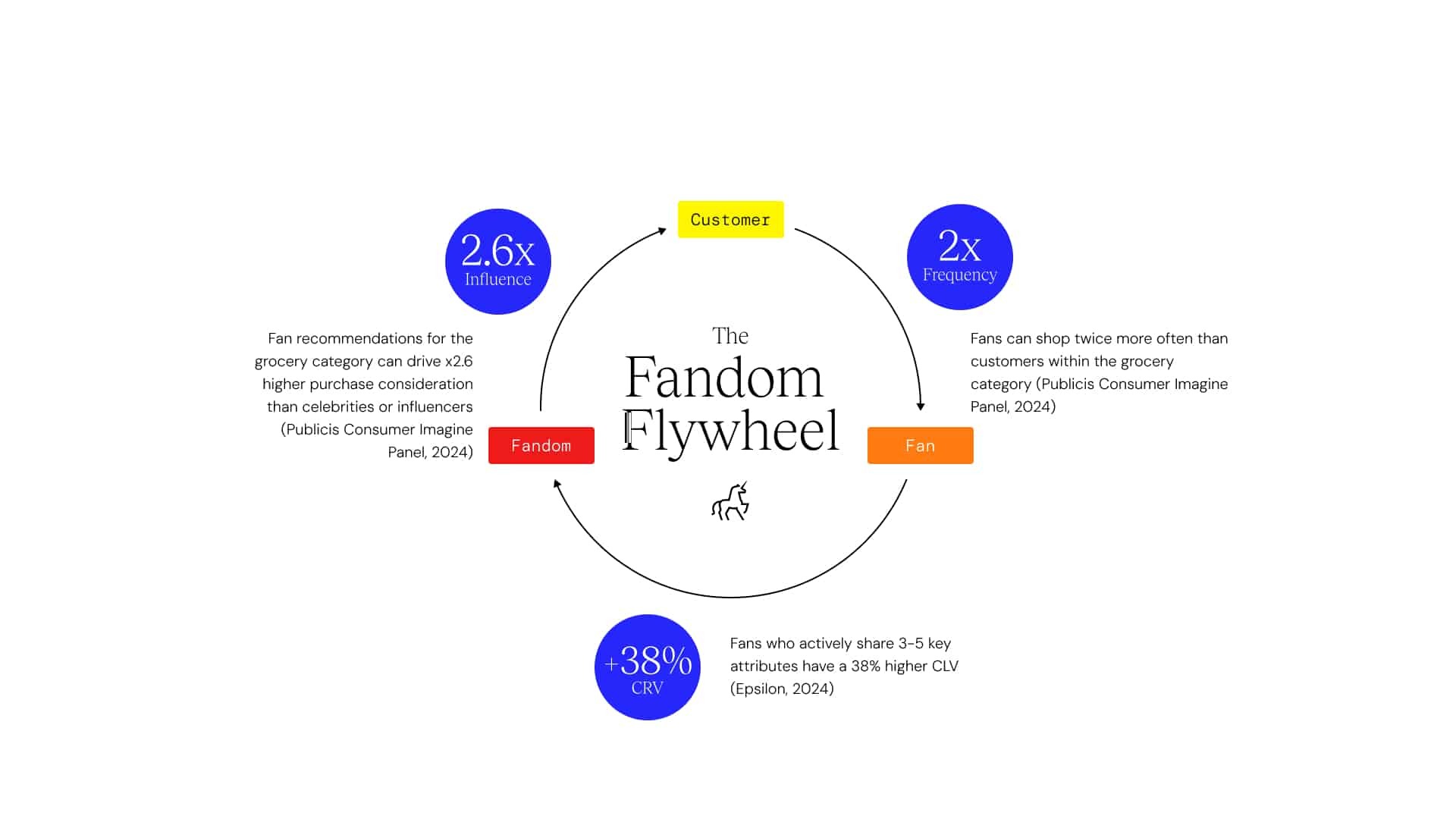
Studies by Zenith Australia’s Consumer Imagine Panel in January and October 2024 showed when supermarket customers become fans, their purchase frequency can double. These studies also revealed that as fans make recommendations, they can drive 2.6 times more purchase consideration than traditional influencer or celebrity marketing.
Fans are more likely to share data, and when fans share three – five key emotional attributes, lifetime value increases by an average 38 per cent (Epsilon, 2024).
The fandom flywheel compounds. And every brand with customers can unlock growth by knowing and growing their fans.
How Brands Can Unlock Build Fan-Fuelled Growth
First thing—size your fandom. Find your true believers. They’re often less than 15 per cent of your base, but drive disproportionate value.
Then find your fandom playgrounds. Act as a fan of what your customers are fans of—but selectively. Not every cultural moment is yours to claim. The power is in the overlap of the fandoms where your customers play and your brand can belong. Just like McDonald’s and their iconic Minecraft x Happy Meal partnership. Or Bundaberg Rum’s deep alignment with the annual ‘Deni Ute Musters’ event. Authentic alignment between brands and fandom playgrounds supercharges connections, increasing customer intimacy at scale.
Measure your ‘Return on Fandom’. Track purchase frequency, customer lifetime value, and earned advocacy uplift to tie fandom directly to revenue, and take fandom from the blogosphere to the boardroom. Just like ALDI’s Superfans (or ‘#ALDIcore’) being 1.4 times more likely to spread their brand love on socials, when compared to ALDI’s total customer base.